Tuesday, March 4, 2025

Mystic Space Playtest 01 After Action Report


 About a month ago I had the opportunity to playtest, in person, the alpha version of the rules for a new wargame called Mystic Space.

Mystic Space is a scifi heroic space fantasy wargame produced and written by Ivan Sorensen, aka Nordic Weasel.  Ivan has created a plethora of solo, coop and verses wargames including 5 Parsecs from Home and 5 Leagues from the Borderlands that are both published by Modiphius Entertainment.  

With Mystic Space, think of colorfully armored armies of humans, and exalted Heroes, along with looming mecha-like Walkers, thundering across the battlefield, heeding the rallying cry and bark of their commanders to rapidly seize objectives and defend them to the last; all for the glory and expansion of their Faction.  In my view, it is a very heroic noble-bright tone with a dash of anime and giant robots, that is missing from most wargames that are focused on the gritty and grimdark.  

Full disclosure, I am on the Nordic Weasel discord and correspond with Ivan, along with playtesting some of his wargames.

I was very lucky in that my playtesting partner, Skeaze, brought two Mystic Space armies (15mm scale) that were sculpted in Blender, 3D printed and even painted, all by his own hand.  Now, how could I refuse?

If you are interested in the digital sculpts that Skeaze has made for Mystic Space, you can check out his Cults3D page, which is here.

Anyway, each side had two Infantry squads and three Heroes.  Mystic Space is a Victory Point accumulation game, and securing the Objectives in the battlespace is one way to accrue Victory Points.  

Infantry is important in Mystic Space because only Infantry squads can claim Objectives. Heroes (at the time of playtesting) could not claim Objectives, but they could contest them.  So, I viewed Heroes as support units for my Infantry.

Claiming an Objective involves an Infantry unit being within two inches of the Objective, and no opposing force being within two inches of that same Objective.

In addition to claiming Objectives, there were rules for obtaining Victory Points by wiping out opposing units.  However, since this was our very first game, and first engagement with the alpha ruleset, we decided to simplify these. 

We decided that reducing an Infantry squad to half strength would result in a gain of two Victory Points, and subsequent annihilation of the same squad would give the opponent one more Victory Point.  Thus, reducing an Infantry squad from full strength to zero members would result in a total of 3 Victory Points gained.

Similarly, the death of a Hero would result in the opponent gaining a total of 3 Victory Points. Thus, if one side was fully wiped out, the opponent would gain a total of 15 Victory Points; 9 from three Heroes and 6 from two Infantry squads.

In the particular scenario we were testing, we decided that we would have four Objectives on the board and that each Objective successfully claimed would give the claimant 1 Victory Point at the end of each turn.

Now onto the forces description.  I mentioned that each side had two Infantry squads and three Heroes.  However, each side was not identical in terms of the type of Infantry and Heroes.  My side was the Terra Hold faction and my forces consisted of 1 Light Infantry Section (eight figures), 1 Assault Infantry Section (six figures), a Leader Hero, Champion Hero, and an Ironclad Hero.  My colors were green. My opponent’s side was the Eden’s Path faction and his army contained 1 Light Infantry Section (again, eight figures), 1 Armored Infantry Section (eight figures), a Leader Hero, Rapid Hero, and Ironclad Hero.

It was not exactly a mirror match but it was close. Light Infantry Sections were sort of your basic army unit. The Assault Infantry Section had decent pistols and more importantly were all armed with melee weapons.  In contrast the Armored Infantry Section fielded by my opponent were a slower moving, but more armored than usual group of eight soldiers armed with rifles and two heavy weapons. 

Both my fellow combatant and I each had a Leader and Ironclad Hero. All Heroes, once activated in a turn, can also activate an Infantry Section within Command Range (6 inches typically).  Leader Heroes have a Command Range of 9 inches, a ranged weapon, a melee weapon, and spells; the latter of which had yet to be fleshed out in the rules so we skipped that entirely.   Ironclad Heroes were a little slower but had the most armor of any unit in the game (4), a ranged weapon that fired twice per shooting action, and a melee weapon.  Ironclad Heroes were very resistant to damage, a factor that we learned throughout the battle.

To differentiate our near identical army loadouts, I had a Champion Hero and my opponent had a Rapid Hero.  A Champion Hero was a melee specialist of sorts; armed with a pistol and a powerful melee weapon.  A Rapid Hero was the fastest Hero in the game; and I expected it to be contesting my Objectives fairly regularly.

Now, there was one additional thing my opponent and I had to consider with each of our force's loadouts. Which units were going to field Trace pistols or Trace guns? Normally in Mystic Space, when a unit shoots another unit, the shooter rolls 1d10 and adds their weapon's accuracy, then adds or subtracts additional factors and compares the result to the value of 10. A result of 10 or higher is a hit, and misses do nothing. Trace firearms function differently. They are essentially railguns and the shooter draws a straight line from the shooting unit to their target. All units that intersect that line are hit, even if friendly. No 1d10 to hit roll is required. A large piece of terrain (like a cliff face) will interrupt the line however.

The Light Infantry Sections and the Champion could field a Trace gun and Trace pistol, respectively. Although, those units that were hit by a Trace weapon will have the chance for an armor save; the way the trace weapons could target multiple figures in a squad made us both pause and consider the arrangement of the figures in our squads when they were deployed on the battlefield and when they had to squeeze into smaller corridors on the map. After all, we didn't want to give the opposing player any advantage of automatically scoring a hit on multiple figures in a single shooting action!

With these thoughts in mind, it was time for deployment of the troops. The battlemap had five major pieces of terrain on it. One piece was close to each corner and a group of ruins was present in the middle. Four Objectives were placed on the table. One Objective each, were placed near me and my opponent's deployment corners. The other two Objectives were in the middle of the map. These were the toxic barrels in the ruins you can see in the first picture (below), and a group of crates tucked away in the crook of the green-topped plateau. These middle Objectives would be the most contested areas during the conflict. 


Deployment was interesting. We used the following rules that may not reflect the final Mystic Space product. Each player placed a number of deployment markers on the battlefield equal to the number of forces they had. We numbered the deployment markers 1-5 (we each had 5 units to deploy) and took turns rolling 1d6. Depending on the number that came up on the 1d6, we would remove the deployment token with that number and place a unit of our choosing on that location on the board. If someone rolled a 6, we rerolled of course, given that we only had 5 units each.

Another note about deployment. The robot miniatures that you will see in the pictures we used as proxies to represent our Ironclad Heroes. There are giant robots in Mystic Space. They are tentatively called Walkers. At the time of the playtest, however, rules for Walkers had not been fully developed.

The first turn proceeded as expected given the layout of terrain and Objectives in the battlespace. I was lucky enough to will the initiative roll, so I went first and immediately had my Assault Infantry Section secure the Objective that was in my corner on top of a plateau. Claiming that Objective would result in production of one Victory Point per turn at the end of the turn. The rules do not require devoting a unit of Infantry to guard the Objective in order to generate Victory Points. This is great because it encourages players to advance all of their forces into the fray. My opponent executed the same plan with his units, claiming the Objective (a satellite dish) that was in the middle of a crater, in his corner of the field. 


In addition, during the first turn, I also rushed my Light Infantry Section into the ruins in the middle of the map to claim the Objective there. The Objective in the ruins was a pile of leaking toxic barrels. Perhaps that was an ill omen for what would happen to my Light Infantry in the ruins! Anyway, at the end of turn one and I was sitting pretty on two Victory Points.

Turn two arose and the shooting began in earnest. My opponent jockeyed for position, arranging his Leader and Ironclad Heroes as well as his Light Infantry within the visual arc of my Infantry squad that had holed up in the ruins, guarding the toxic barrels Objective. I suffered a withering hail of fire. The result was that five of my Infantry, out of eight soldiers, had been penetrated by lasers or burnt to a crisp by plasma fire.

Things were not looking good. However, my much-diminished Infantry squad rallied, successfully removed the panic markers caused by the decimating firefight, and were able to return fire. Shocked that my Light Infantry force was so close to destruction so soon, I moved my Champion Hero into the ruins to support them.

Another flash point was erupting. Due south of the ruins and in a narrow corridor bordered by crumbling stone and two grassy plateaus, my Assault Infantry had spied and were in range of my opponent's colorful Armored Infantry. Accompanied by an Ironclad and Leader Heroes, my Assault troopers fired enfilade into the mass of enemy troops, inflicting three casualties (denoted by the smoke tokens in the below picture). The opposing Hero, the Rapid, stood and delivered; making all of his armor saves against the firearms of my Ironclad Hero and shooting back with impunity.

Meanwhile, in the ruins, the remainder of my Light Infantry screamed and fell under the combine arms of my opponent's Light Infantry Section and Ironclad Hero. Brimming with confidence, the opposing Leader (figure with a red pistol and blue sword) engaged my Champion (pants painted in green) in close combat. He also proceeded to engage his remaining Light Infantry Section with my Champion as well, hoping to gain advantage and dominate my Champion by obtaining bonuses to hit by surrounding him.

Satisfied that his forces would wipe out my Champion, my opponent moved his Ironclad from the ruins combat to the southern narrow corridor flash point. Things looked far from great for me.

However, that is when we came face to face with how dominant a Champion's melee skills were. My Champion weathered a storm of blows from Hero and Infantry alike, and then returned blow for blow with force and honor. When the butcher's bill came due, my opponent's Leader lay dead on the ruined ground and two men of the plucky but foolish opposing Infantry squad were smashed to a pulp.

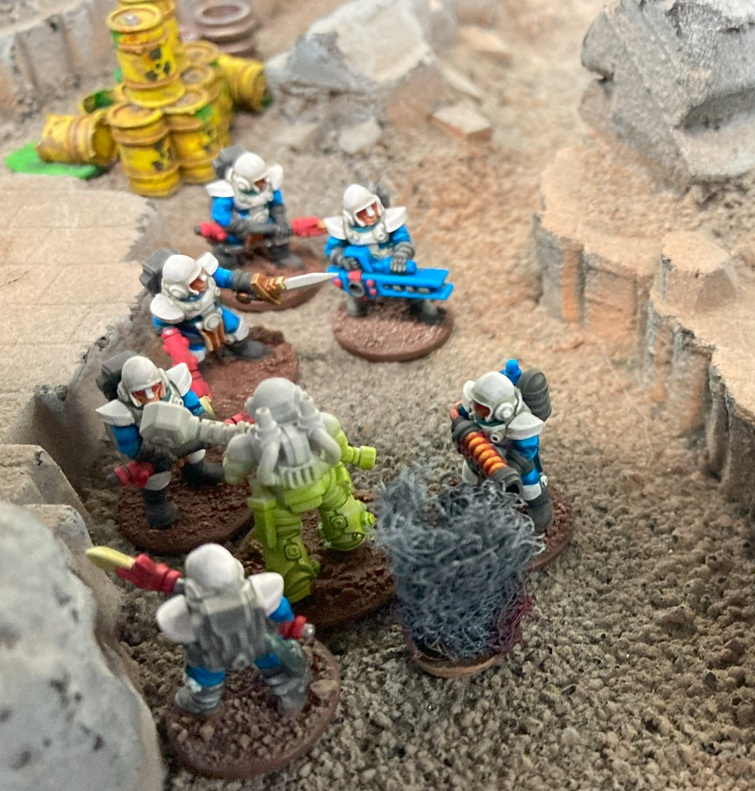
The conflict in the southern corridor was claiming lives and becoming tense. As soon as my counterpart's Ironclad came to support his diminishing number of Armored Infantry, the armor save luck of his Rapid Hero ran out. My Ironclad finally finished off the Rapid in a barrage of Injector rifle fire.

The close quarters firefight quickly turned into a muddy, bloody melee where no side was spared. My Assault Infantry engaged his Armored Infantry and slowly, painfully, the slightly superior armaments of the Assault squad ground the superior numbers of the Armored Infantry to dust. Two lone Assault squaddies stood triumphant atop of a mound of bodies, heaving with labored breaths and brandishing their Honor Blades in victory. 


In the central ruins, my Champion valiantly parried strikes and withstood blows that would crumple a lesser human, but quantity has a quality all of its own, and my Champion disappeared under the tide of the opposing Infantry's pummeling rifle-butts and thrashing fists.

All told, we tallied up the casualties and Objectives that accrued Victory Points and came to a conclusion. My opponent stood tall with pride, having claimed victory from the jaws of defeat by a single point! 

Mystic Space is shaping up to be a great game with lots of action, drama and tactical decisions on display. More current editions include rules for the giant robots called Walkers, special bonuses for Factions, and lore about the conflict and the major players within it. Even more is to come including a Spell list and rules for Faction Artifacts. I'm very excited about the developments and I can't wait to play it again. 


Wednesday, November 20, 2024

Delta Green and the House Committee on Oversight and Accountability investigation on UAPs


The House Committee on Oversight and Accountability had an investigation on UAPs on Wednesday 11/13/24. UAPs are Unidentified Anomalous Phenomena, which is what we are calling UFOs now.  The whole session is about 2.5 hours. It is here.

Several interesting topics were discussed with respect to with respect to what parts of the US government knew about UAPs and what are affectionately called NHIs or Non-Human Intelligences. Some of these claims are absolutely wild, but all of this discussion is absolute gold for Game Masters of conspiracy and occult roleplaying games like Delta Green.  I will be highlighting some of the more interesting real-life tidbits discussed or reported in the committee meeting with an eye to how these can be used in a fictional Delta Green roleplaying setting.  Significant spoilers for the Delta Green setting will follow.

The Witnesses

First let us discuss the four witnesses at the House Committee Meeting on UAPs and their fields of expertise.  Dr. Tim Gallaudet is a Retired US Navy Rear Admiral, and CEO of the Ocean STL Consulting company. He described what is known as the “Go Fast” video (declassified), in which a UAP was observed during naval exercises off the US East Coast in which the USS Theodore Roosevelt CSG (Carrier Strike Group) was present.  His testimony seems to reveal a silencing of UAP discussion in military ranks and describes UAPs observed in the ocean as well, specifically describing these UAPs as “exhibit[ing] transmedium travel through the air-sea interface.” 

Luis Elizondo is a former Department of Defense official who has managed SAPs (Special Access Programs) during his tenure. His answers to most of the questions from the House involved requesting a closed session (non-public) in order to describe an answer. I’ll just quote from his written testimony here:

“Let me be clear: UAP are real. Advanced technologies not made by our Government – or any other government – are monitoring sensitive military installations around the globe. Furthermore, the U.S. is in possession of UAP technologies, as are some of our adversaries. I believe we are in the midst of a multi-decade, secretive arms race— one funded by misallocated taxpayer dollars and hidden from our elected representatives and oversight bodies.”

True or not, this statement is chock full of inspiration for Delta Green. 

Michael Gold is a scientist. He is the former NASA Associate Administrator of Space Policy and Partnerships and member of NASA UAP Independent Study Team.  His interest in UAPs mostly comes from a “they display unknown physics and thus we should study them” perspective, and he believes NASA should be the departmental clearing house for UAP data.  Also, he advocates for additional NASA funding. Shocking.  Here is a quote from his written testimony:

“Moreover, science is driven by anomalies. Anomalies are the foundation upon which scientific breakthroughs are built. The Theory of General Relativity, Quantum Mechanics, virtually all of our scientific progress has been based on discovering and studying anomalies.  This is why the study of UAPs should be embraced since, whatever is occurring, the chance to garner new knowledge should never be shunned.”

Now in real life this is a laudable and admirable stance. Not so, in the fictional Delta Green universe! In fact, the progress of science into understanding the true nature of the universe is dangerous to human minds. As Lovecraft said:

“The most merciful thing in the world, I think, is the inability of the human mind to correlate all its contents. We live on a placid island of ignorance in the midst of black seas of infinity, and it was not meant that we should voyage far. The sciences, each straining in its own direction, have hitherto harmed us little; but some day the piecing together of dissociated knowledge will open up such terrifying vistas of reality, and of our frightful position therein, that we shall either go mad from the revelation or flee from the deadly light into the peace and safety of a new dark age.” From the Call of Cthulhu.  

Michael Shellenberger is a journalist.  He brought an 11-page document to the House Oversight Committee that described the Special Access Program IMMACULATE CONSTELLATION. IMMACULATE CONSTELLATION’s objective was to collect imagery and other intelligence on UAPs, thus serving as a clearinghouse for the activities, capabilities and locations of UAP activity.  Shellenberger also included, in his written testimony, almost 200 pages of references and public domain information about UAPs.  Some of these UAP references go back to 1947, making Shellenberger’s written testimony a nice timeline for UFO/UAP history for Delta Green Game Masters and interested parties.

Excerpts from the Document that Describes IMMACULATE CONSTELLATION

The document provided to the House Oversight Committee by Michael Shellenberger regarding IMMACULATE CONSTELLATION does not have a title. I will refer to it as the IMMACULATE CONSTELLATION document or the IC document for brevity. 

According to Shellenberger’s written testimony, a UAP whistleblower (current or former US government official) has claimed that “the Executive Branch has been managing UAP/NHI issues without Congressional knowledge, oversight, or authorization for some time, quite possibly decades.” NHI is the acronym for “Non-Human Intelligences.”  This unnamed whistleblower (or another, it is not clear to me) claims that the Department of Defense created IMMACULATE CONSTELLATION in 2017 and denied it’s existence. That is the history. 


In the IC document’s introduction, the document claims that parts of the U.S. Executive Branch conspired to block Congress from becoming aware of and doing anything about UAP and NHI issues in a so-called criminal conspiracy. In fact, it also “strongly suggests” that the Executive Branch has been managing UAP/NHI issues possibly for decades. 

Now, how does this apply to the fictional setting of Delta Green?  Ironically (or not) this fits in perfectly with the idea that Majestic 12 has been managing contact with the Mi-go and read in every Executive Branch member about this interaction through President George H.W. Bush (Bush 41) (see the Handlers’ Guide p.94).  This is not the only bit of UFO lore that supports the fictional argument that the U.S. Executive Branch has been aware of UFOs/aliens, but I think it is one of the most recent. 


The IC document goes on to claim several documented encounters of the US military with UAPs.  One of the more interesting reports is of “CENTCOM Cuboid Formation of Metallic Orbs” in which approximately 12 “white-hot” metallic orbs flew in a “tight ‘cuboid’ formation” then broke formation as pairs at speed. The cuboid was observed over the ocean in this case.

So, what could this be in the Delta Green universe? Generally, UFOs sightings are considered the domain of the Mi-go so let’s go with that idea.  Any civilization advanced enough is going to have drones, evidently, so let’s say these metallic orbs are drones from a Mi-go source; be it a technological Grey spaceship or released by a Mi-go practitioner of hypergeometry.

Why would Mi-go drones be in the area? I have two proposals. First the Mi-go are tracking another Mythos agency and they don’t care if the hapless hairless apes see their drones because the mission is that important. I could see perhaps the Mi-go drones going after shoggoth activity beneath the waves or collecting data on some undersea Elder Thing base that they have just become aware of.

Alternatively, since the white-hot metallic orbs were captured in daytime infrared footage, we may assume there was some sort of military platform nearby that was observing the event.  Let’s imagine that this sensory platform was accompanied by a ship owned by March Tech in which hypergeometically aware March Tech researchers (i.e. wizards-in-training) were trying to restart some piece of now dead Grey tech, and the Mi-go wanted to monitor the situation.  When the Mi-go finished, their drones broke formation and went to observe some other sites for other inscrutable purposes. 


In Section 5: Restricted USG Historical Records section of the IC document, it was reported that there was an NSA report published in 1978 on the topics of parapsychology, 'psi' and biological effects of UAPs on human beings being researched in the Soviet Union.

This little tidbit would be fantastic to drop into a Delta Green game, a GRU SV-8 game or a game that featured a conflict between cells of the two organizations.  In addition, if a Delta Green Game Master wanted details on what biological effects of UAPs have on human beings, just consult the tables on page 6-9 of the IC document or examine the Defense HUMINT Reports on UAPs on page 9. 


One of the interesting Defense HUMINT Reports on UAPs is the Perimeter of Sensitive Facility Breached by UAP report where somewhere on the Eastern Seaboard a "dark sphere" was observed approaching a sensitive building for 10-15 minutes. Humans observing the phenomena "reported eyestrain, headaches, and a feeling of unease or dread".

What if those UAP biological effects, namely "eyestrain, headaches, and a feeling of unease or dread" were somehow researched and then weaponized by March Tech or GRU-SV8?  Imagine an invisible "dread wave" that could be targeted and the device that deploys it is the size of a suitcase.  Such a device could be utilized to clear an area or building of humans (or maybe animals as well) quickly without say shooting up the place or causing unnecessary panic. This would be a wonderful tool for a Coral Nomad (Delta Green’s Mythos artifact retrieval agency) team to have to secure Mythos remnants and or artifacts from a hot site.  

And you could connect the "dark sphere" UAP’s effects on biologicals with the Music From a Darkened Room adventure.  You could say the sentient house emits a waveform of energy that matches the one "dread wave" studied from the "dark sphere" UAP and thus Delta Green is aware of this and interested in the site as a result. Or you could pull the reverse, have the Agents investigate the haunted house first, and then drop on them that something in the house produces a "dread wave" that is similar to those emitted by certain UAP phenomena. That could pull the Agents into investigating UAP phenomena (maybe Convergence?) and your next adventure. 

And I have to just include this last part because it is lovely on so many different levels. The document ends with "Be not afraid." Isn't that the phrase that the Archangel Gabriel said when the angel appeared to Mary in the Bible? 

Really guys, really. It's too good.

Interesting Questions for the Witnesses

Congresswoman Lauren Boebert asked the following questions of the Witnesses in the House Oversight Committee. 

Congresswoman Lauren Boebert: "There are rumors that have come up to the Hill of a secretive project within the Department of Defense involving the manipulation of human genetics with what is described as non-human genetic material for the enhancement of human capabilities, hybrids. Are any of you familiar with that? Yes, or no?"

The unanimous answer by the witnesses was no. 

Also, Congresswoman Boebert: "Are there any accounts of UAPs emerging from or submerging into our waters which could indicate a base or presence beneath the ocean's surface. Are there any technological capabilities that have been observed in these oceanic UAPs to defy our current understanding of physics or human engineering capabilities?"

In the Delta Green world, let us assume that both of these statements reflect a literal reality.  Human-alien hybrids are real and there are alien bases under the water where the aliens that control the UAPs plot to over take the surface world.  This describes pretty well the world of X-COM: Terror from the Deep, the 1995 the video game and sequel to the original X-COM: UFO Defense. So why not crib from MicroProse’s legendary sequel to enhance your Delta Green game?  This works best if you want your Delta Green Agents to morph from an investigative team into a kinetic anti-alien squad armed with laser rifles and the like.  Much of the lore from X-COM, in particular Terror from the Deep, leans on Lovecraftian themes so a Delta Green campaign or one-shot could fit right in.


Yet Another Mythos Theory for UAPs

One issue about the UAPs described in the IMMACULATE CONSTELLATION document is that they vary widely in appearance. This begs the question, why? Allow me to supply a scifi/Mythos related answer. What if UAPs do not originate from a different place, but in fact a different time?  This is not a new theory in UFO lore but let’s go with it.  Let’s say humans eventually figure out time travel, but not in a singular location with a single researcher or group.  Let us say several nation states or corporations or whatever discover and develop time travel in the future simultaneously.  The UAPs are time traveling drones or observers from our future but the catch is they all use differently shaped craft because they all have different means of moving through time. 

Now, why are the time traveling humans here? And why are the UAPs seemingly increasingly focusing on military sites in our present? This is where the Mythos comes in.  In the Delta Green Handlers Guide on page 149 there is described a temporal war between The Great Race and the Lloigor.  To summarize the war, these two Mythos factions want either a radioactive future earth where a species of giant beetles dominate the planet, the Great Race’s desired outcome; or a sinister future human empire called “Tsan-Chan” to rise on Earth in approximately 5000 CE, the Lloigor’s objective.   The Lloigor’s objective is seemingly in direct conflict with the Great Race’s plans for a massive human nuclear war, as the Handler’s Guide says. Future human time-travelers could serve as agents of one of the two aforementioned factions, or they could be an independent third faction that has their own goal of a more human focused future.  

If the future human time-travelers are opposing the Great Race, you could say that the UAPs frequent nuclear arms sites and nuclear research locations and that these sightings are correlated with nuclear weapons mysteriously losing effectiveness or nuclear scientists reporting amnesia. If the future humans are opposing the Lloigor, then say the UAPs are congregating around Mythos sites, as the rise of Tsan-Chan is associated with the return of the Great Old Ones from their slumber. In this latter case UAPs may actually help Delta Green Agents, either as serving as markers for previously unknown Mythos hotspots or with some direct future-tech or hypergeometrical support.  

Whatever you do, there are plenty of inspirations for an occult conspiracy game in the documents from the UAP House Oversite Committee hearing.  Happy Gaming. 

Thursday, September 26, 2024

Fear, Writing and Roleplaying Horror Games

 It’s that time again! The seasons have rolled over to orange and black and there is a chill in the air. That means it is almost time once again for the Delta Green Shotgun Scenario Contest, 2024 edition!  Yaaay. But what to write and how do you put together a Delta Green adventure, let alone a 1500-word-maximum banger as stipulated by the Shotgun Scenario Contest? 

Lots of people have difficulty writing horror and/or mystery scenarios, including myself. So, I wanted to share with you some of the most useful and inspiring books and essays that I have discovered that touch upon writing mysteries, the nature of fear, and tabletop adventure architecture.  Along our journey I’ll throw in references that help with Game Master advice as well.

Dance Macabre by Stephen King

First of all, to discuss what fear and the horror genre is, we should have a working framework; and Steven King’s book Dance Macabre provides this concretely as it makes a distinction between the gross out, horror and terror in horror media and fiction. Dance Macabre is a lovely book that goes over horror fiction in all sorts of media, but it goes into great depth on horror in film if you get the version republished after 2010.  The discussion on horror in film can be particularly of use to film students and Handlers who want to focus on cinematic descriptions in their game.

King’s breakdown of fear into the three facets of the gross out, horror and terror is well articulated in the book, and Handlers could keep in mind these three categories to figure out what emotion they want to evoke in their players with a given horror game description, plot point or set piece.  I read Dance Macabre a long time ago; the fact I still remember it is a testament to the clarity and impact of Stephen King’s analysis. 

Stealing Cthulhu by Grahm Walmsley

The second book that offers sterling advice is Stealing Cthulhu by Grahm Walmsley.  This book is amazing. Only $6 on DriveThruRPG, it is invaluable for Cthulhu Game Masters of any stripe.  What Grahm Walmsley has done is make an algorithm for remixing and permutating tropes and themes from a body of literature to come up with something new, yet firmly based upon the source literature.

 Applying this to Lovecraft’s work, Walmsley’s strategy generates new takes on Mythos monsters, interesting recombinations of HPL’s literary themes, and reworked scenarios that are fresh and new to even veteran Cthulhu players.  However, I call Walmsley’s strategy an algorithm because it could be applied to literature as diverse as Agatha Christie to Jim Butcher.  Just any author with a moderate to large body of work.

In addition to that, there are footnotes galore from leading Cthulhu adventure writers in the field (Kenneth Hite, Gareth Hanrahan and Jason Morningstar) giving invaluable gaming advice.  As if that were not enough, Walmsley also included a copy of his rules light game Cthulhu Dark in the appendices. I can’t recommend this book enough.


The Trajectory of Fear by Ash Law

The Trajectory of Fear by Ash Law is a 9-page essay that breaks down fear into four components and offers a roadmap for applying those components of fear in a roleplaying game using film as a model. Ash defines the components of fear as Unease (that spooky feeling), Dread (the uncertain possibility of certain danger), Terror (the immediate sense of danger, but the danger has yet to be exposed) and finally Horror (the primal fear that occurs when the danger is revealed).

Using the movie Alien and a couple other films as examples, Ash posits how those components of fear can be applied in the arc of a horror roleplaying game session to effectively scare your players.  He also gives examples of how horror games can be done poorly, specifically by referring to schlocky horror in film.  I think Ash’s advice is best applied by a cinematic focused horror Game Master.

The Trajectory of Fear is best found for free at the Internet Archive here.


Games of Fear by Delapore Media

Delapore Media, authored by Dr. Stephen E. Wall, wrote a three part blog series called Games of Fear focusing on fear from a physiological and cultural perspective, and how to apply specific fears such as disaster, social hysteria and fear of strangers to your roleplaying game.  The last essay contains a discussion and analysis on the weird and the eerie with advice for the reader on how to include those elements into writing and roleplaying horror games.

If one is curious about taking a deeper dive into the study and definition of fear then Delapore Media includes interesting references throughout the series of essays, including Margee Kerr’s Scream: Chilling Adventures in the Science of Fear.  As a note, I disagree with Delapore Media on a few points, specifically that "Fear isn’t primal, its cultural." As an unresearched hypothesis I think that fear can have a definite genetic and evolutionary component; but does that affect writing to scare your players in games? No. I think the essays have useful elements, thoughts and techniques to help scare players at the table.


5 Node Mystery by The Alexandrian

Hand and glove with horror stories are mysteries.  Most Delta Green adventures, and that includes shotgun scenarios, will revolve around a mystery, at least in part. But writing a mystery seems daunting. How does one begin?

Many online roleplaying enthusiasts are familiar with The Alexandrian for his advice on game structure, but did you know that he also wrote an article titled the 5 Node Mystery?  Deriving his theory from the stripped-down essentials of a five-node dungeon crawl, the Alexandrian presents a framework for how to present a mystery scenario to player characters by asking five essential questions: what is the mystery about, what is the hook, what is the conclusion, what are the three locations/people linked to the mystery, and what clues are you using to connect the nodes in the mystery. 

When a Game Master decides to come up with clues to bind the mystery together, I would also argue that TheAlexandrian’s Three Clue Rule is also very useful.  Thanks to Lithobraker on the Night at the Opera discord for bringing the 5 Node Mystery blog post to my attention.

The Conspyramid by Ken Hite in Night’s Black Agents

You’ve run a successful horror game one shot. Great! But now the players are clamoring for more. What do you do?  How do you organize and manage a horror campaign? 

One framework I like a great deal is Night’s Black Agent’s Conspyramid. The Conspyramid is a portmanteau of “conspiracy” and “pyramid”.   Visualized as a six level step pyramid, the Conspyramid allows a Game Master to plan and organize their enemies resources, with the prime evil himself at the top, middle managers in the next few tiers and street/entry-level threats at the bottom.

The connections between the nodes of the pyramid allow for the Game Master to outline what methods of control exist between the nodes or what clues can lead the party from one node to another. It is a fantastic tool with many different applications outlined in the Pelgrane Press’ article here.  Constructing a narrative campaign from seemingly disconnected parts is easy to do when the Game Master can visualize the entire plot with a Conspyramid.

Want to know more about the vampires and spies’ horror game that birthed the Conspyramid, Night’s Black Agents? Take a look at the review of NBA by The Alexandrian, here. Night’s Black Agents, itself can be found here.   

Available here

Mythos Revelations by The Alexandrian

I’ve mentioned The Alexandrian’s blog above. This time I want to highlight The Alexandrian’s specific advice on how to handleMythos-style horror and forbidden tomes in game.  These advice blog posts came out relatively recently, August 25th and 27th of 2024.  The Alexandrian first tackles the problem of maintaining the horror and mystery of a supernatural being or Alien God by breaking information about that being into three levels of abstraction.  Then he suggests providing the abstracted and mythologically obscured information as scraps of revelation, namely clues, that can be found by players in accordance with the Three Clue Rule (discussed above).  This strategy is very cool, well described and makes intuitive sense to me.

Handling Mythos tomes is somewhat complementary to doling out clues to a Mythos being.  Specifically, The Alexandrian states that said tomes should be handled as a specific clue vector and/or research resource.   In addition, The Alexandrian continues with some musings on creating Mythos tomes for a campaign and gives examples that refer to his very excellent remix of the Trail of Cthulhu epic campaign Eternal Lies.


Creepiness, a How-To Guide and Delta Green: Making Horror Scenarios, both by Dennis Detwiller

Dennis Detwiller, along with John Scott Tynes and Adam Scott Glancy, created Delta Green. Needless to say, Dennis has some opinions on horror and how to apply it to roleplaying games.

The first of Dennis’ guide to horror is Creepiness, a How-To Guide which was published in 2013 and can be found on Delta Green’s official website. 

Short but useful, Dennis offers advice about five elements to maintain in a horror roleplaying scenario. These include: keeping the mundane as the background of the scenario, emphasizing uncertainty in the player’s mind, cementing the idea that Mythos horror is unable to be comprehended by humans, making death omnipresent, and introducing the idea that there are things much much worse than dying.

Dennis’s 2015 essay Delta Green: Making Horror Scenarios sort of springboards off of his 2013 guide but it is much more detailed and it focuses on how a Game Master can make a Delta Green specific horror game.  In this essay, he first presents his analysis on what horror games are about, then he moves on to describe the types of horror one can encounter in roleplaying games, and the structure of horror scenarios. The latter half of the essay is devoted to walking the reader through how he creates a horror scenario from first principles; including the Hook, how to make relevant and interesting horror NPCs, the connections of the mystery that Dennis calls Leads, creepy Moments or set pieces, Events that occur independently of the players, and finally Solutions for the problem introduced in the Hook.

Delta Green: Making Horror Scenarios can be found on Dennis Detwiller’s Patreon.


Write Delta Green Scenarios the mellonbread Way by mellonbread

mellonbread is the founder of the Night at the Opera, one of the largest Delta Green fan created discords, and a prolific writer.  His body of work includes over 100 Delta Green fan scenarios, which is hosted on his blog, The Rogue’s Wallet.

In May 2022, mellonbread published an essay for the free Delta Green fanzine Whispers of the Dead, detailing specific advice about his writing process, including how to link ideas together by layering a connective tissue of clues, adding reactivity, making interesting NPCs, and how to develop the hook of the scenario. mellonbread then goes on to discuss the philosophy he applies for running Delta Green games including his view that it is good to be generous with magic items, spells and the Unnatural skill points.  The latter opinion is derived from mellonbreads’s thesis that a Game Master should above all else make the scenario interesting, and push the interesting components to the fore. He ends the essay with a statement that I think rings true regarding writing scenarios. “Create the content you want that nobody else will write.”


Sources I Haven’t Read

In addition to the above references about fear in roleplaying games, there are additional veins of wisdom crystalized in various places on the internet.  Two of which I am aware of, but have not read yet as of the time of this writing are Call of Cthulhu d20 by Monty Cook and John Tynes and GURPS Horror (currently in 4th edition) written by Ken Hite. ControllingCrowds from Night at the Opera discord brought Call of Cthulhu d20 to my attention and he recommends the Game Master advice in the book. I will point out that John Tynes is one of the co-founders of Delta Green and pretty much reshaped the Hastur Mythos with some of his ideas about the King in Yellow and Carcosa, and this was before Dennis Detwiller published Impossible Landscapes. So, I welcome, no am rabid for, any more advice I can find by John Tynes. The hitch is that Call of Cthulhu d20 was published in 2002 and is a bit difficult to get a hold of.

Another luminary of the field, Ken Hite, who I discussed when mentioning the Conspyramid (above), has written GURPS Horror and I understand the advice contained in there on fear in games is also very good. GURPS Horror is much more accessible because it can be found on DriveThruRPG.  

Wednesday, September 18, 2024

Forbidden Psalm: Endless Horrors From Between The Stars, Book Review

All Endless Horror art posted with permission

 
Forbidden Psalm: Endless Horrors From Between The Stars is a skirmish wargame built with solo/coop/verses modes in mind about five cultists striving to awaken their Endless Horror and bring about the End Times.  Written by Will Rahman, of Forbidden Psalm fame, and illustrated by artist Vil, Endless Horrors was kickstarted June 1st 2024 and the digital copy was fulfilled August 28th 2024. I was a kickstarter backer and I have in my hot little hands a pdf copy of the 168 page grotesque and disquieting wargame.

It is really cool and I hope you find it exciting as well.    

It is not yet available from DriveThruRPG, but give it time. The Stars must become Right.

Edit: The STARS ARE NOW RIGHT! Endless Horrors is available at DriveThruRPG here and itch.io here.

Endless Horrors and Cults

One of the first things you do in Endless Horrors is create your titular Endless Horror!  This is the Great Old One or Elder God that your cult worships and commits horrible acts of murder and mayhem for.  The procedure for this is to roll 3d100 to determine your Endless Horror’s Description, Purpose and Desire.  There is one d100 table for each attribute.  Your Endless Horror’s Description is simply an evocative adjective. Purpose and Desire have game mechanical effects.

An Endless Horror’s Purpose gives every cultist of your cult a special ability. The Endless Horror’s Desire gives your entire cult a bonus to Rituals under certain conditions. These conditions vary from the thematically mechanical (+1 to Ritual for each Dead model on the table) to the silly (+2 to Ritual if you have eaten lunch today).  This is important because each successful Ritual casting during the game increases your cult’s Zealotry score, and your cult needs a Zealotry of at least 10 to attempt the Final Ritual to awaken their Endless Horror once and for all to successfully conclude the campaign. 

Next you have to choose the Era your unholy crusade is set in, and detail the advantages of your cultists and cult leader. There are three Eras to select for your tale of doom: Medieval, Turn of the Century, and Modern.  Each time period has its own set of weapons and equipment. So, the wargame could be a shooting war or a melee frenzy depending on what you pick. You can choose equipment from an earlier Era if you so desire.  Want to throw a slavering cultist into melee armed with a great knight sword and full plate against a firing line of enemy cultists armed with shotguns? You can do it.  Want to see how the humble crossbow fares against a cop with a taser? Go ahead. Your Endless Horror welcomes the entertainment, or at least drools and burbles to itself.

In addition to choosing a stat block for your cultists, you must also roll a Flaw and Feat for each cultist in addition to a name. Flaws are disadvantages rolled on a 1d20 table that make your cultists a little quirky. For example, it’s possible that Jimbob is delicious to all Horrors on the board or Uncle Frank turned feral and now can only bite enemies instead of using weapons. What. You are managing a cult, not a regimented warband of trained soldiers, so roll with the punches.

On the flipside of this, your motley crew of half-crazed miscreants does worship an Endless Horror with Godlike powers. Every cultist gets a Feat, also randomly rolled on a 1d20 table.  Your minions might have a body made of worms (essentially gains an additional point of armor), or be bestowed with a new mechanic. In the latter case, the Feat Take My Flesh allows a cultist to sacrifice a limb to succeed on a roll where they would have failed. Feats often open up new strategies for your cultists, however the randomness leaves it a bit gonzo.  Still, that is consistent with the game’s tone. After all, if you roll 99 on your Endless Horror’s Desire roll, It simply wants red balloons. Sing it with me now.

Choosing your Cult Leader benefit adds much needed focus to your warband and is the cherry on top of having a cult in the first place.  The player’s choice for cult leader range in benefits from having a hardy warrior that can bring the pain to your enemies, wizards that leverage the arcane power of Manuscripts in the battlespace, leaders who can guarantee your cultists pass their morale checks, and archvillains that enhance your chances to successfully cast Rituals.     

Mechanics and Actions

The central mechanics of the game are simple. If there is a test for something on the battlefield a success is a roll of 12 or higher on 1d20, unless otherwise indicated.  This is called a DR12 check. As is tradition, a 1 is a Fumble and a 20 is a Crit success.

When units are activated on the battleground, each unit can carry out one move, then one action. There are 10 distinct actions that can be carried out.  The ones unique to Endless Horrors are include: use a Manuscript, and convert a Civilian.  Manuscripts (magical scrolls) are one of the ways random weirdness is injected into the game, because each Manuscript has a Failure condition. In addition, a fumble when using a Manuscript invites a roll on the Calamities table, which may spawn a Cosmic Horror, or turn all your unit's items into Wooden Ducks.

Converting a Civilian is a critical action in Endless Horrors because success in this endeavor builds up your cult’s Zealotry level, which is crucial for successfully pulling off a Ritual and bringing down the End Times upon us all.  Functionally the cult’s Zealotry value also gives a cultist a bonus on converting further Civilians to their cause, causing a small but useful positive feedback loop because of the following rule:  if two Civilians are converted in a Scenario, then the cult gains one Zealotry. 

In addition to the previous rule, in Scenario 1, which your cult will likely repeat a couple times, for every five Civilians that are converted the cult earns an additional Zealotry point. So, converting five Civilians should earn the cult a net gain of 3 Zealotry (twice 2 Civilians are converted, and once 5 Civilians are converted) in Scenario 1.

The Infamy value for your cult is a measure of how well known your cult is and how much opposition they are going to attract in a given Scenario.  Infamy increases in value when your cult does horrible cult-like things such as completing Scenario objectives, killing/converting Civilians and killing any Knights/Investigators.  What are Knights/Investigators? Remember those nasty disruptive player characters from a Call of Cthulhu or Delta Green game that interfere with the glorious and transformative actions of a noble cult of the Outer Dark? Knights/Investigators are those guys. They are called Knights if you choose the Medieval Era to play in and Investigators if you play in Turn of the Century or the Modern Era.

When your cult’s Infamy reaches 20, all Civilians become Hostile to your cult, meaning that Civilians will be fully resistant to attempts to convert them, and try to attack your cultists. An Infamy value of 25 or more will result in one of your cultists being captured and taken away by investigators.  On the flipside, a cult with an Infamy higher than 10 gains an additional 100 Resources from “hidden donors” after each Scenario they complete.  Resources are cash, gold or whatever that can be spent to buy Equipment, Weapons and Armor.   I am not real sure what to think about the Infamy stat and the breaks it puts on cult growth. I’ll have to playtest this mechanic in order to come up with a valid opinion. 

Campaign Scenarios and Antagonists

I’ve already mentioned Knights/Investigators and Hostile Civilians.  Also opposing you are cults of enemy Endless Horrors, hostile mystic creatures, and the Cult of the Crawling Eye. It’s a busy occult underground, and danger lurks around every corner.  A note about the Cult of the Crawling Eye. Most enemy Endless Horror cults follow “normal” enemy AI behavior, but the Cult of the Crawling Eye is more insidious. Their members will move to convert Civilians into more cultists of the Crawling Eye, kill any unit that has been Downed on the battlefield, and try to start Rituals if they physically meet their cult brethren. These Rituals can summon all kinds of nasty Horrors into the area, including an Avatar of the Crawling Eye.  In short, the are a pain in the ass with attributes that make them more dangerous if they are ignored and time moves on in the Scenario. So, if you see them, kill them quick. Failure means your very eyes will be forfeit.

Every once in a while, a player of Endless Horrors might get the deviant idea that cults are a bad thing and should be stomped out. If you are a victim of this malaise of goodness and purity, rejoice!  The author has included full rules for you to play all 11 Scenarios in this book as Knights/Investigators.  They even have their own Feats, Flaws and names tables. This also opens up the possibility of playing verses mode where an Endless Horror cult takes on Knights/Investigators in a bloody confrontation. Carry out this gripping conflict in the middle of one of the prepared Scenarios for maximum violence and craziness where there may be third and even fourth parties with their own agendas.

There is a lot more I haven’t covered, like Artifacts, Avatars and their procedural creation, Blessings and Injuries in the Campaign system.  For 168 pages Endless Horrors is a meaty book. And I would be totally remiss if I didn’t mention the artwork. It is deliciously deviant, genuinely grotesque and eye-poppingly eldritch. In short, it is another great Forbidden Psalm art book that could serve as a lovely coffee table discussion piece in your cult headquarters.


Final Thoughts

I also must mention about the Tengoku Station expansion.  Hankering for a scifi Era Endless Horror setting where all of humanity is packed into a claustrophobically crowded orbital station where people can barely breathe unless of course you are one of the elites? Want to see it all burn? Get Tengoku Station. I’ve only read it once so far, but if you are a fanatic about Endless Horrors, it adds what you will like.

That’s all for now. I’m currently planning my cult’s weapons and equipment loadouts with the expectation to crush another cult in a verses game on Tabletop Simulator.  If all works out, I’ll detail that experience in an After Action Report next time I talk about Endless Horrors. Until then, go Burn the Sun.


Tuesday, September 10, 2024

Delta Green and Genetic Editing of Humans

 A Nature Briefing on the subject of gene editing slid into my emails a bit ago. It stated the following:

“In 2018, biophysicist He Jiankui kicked off a firestorm of controversy when he announced that he had edited the genomes of three embryos, resulting in the birth of the ‘CRISPR babies’ — an act that ultimately landed him in prison for three years. Nevertheless, some scientists are planning for a future in which gene editing babies eliminates certain diseases. Most scientists think it is unethical — at least for now — to introduce genetic mutations that can be passed to future generations. But the general public might be more sanguine: a survey [2023 published in Science] showed that 30% of people would edit their children’s genomes to improve the child’s chances ofattending a top university.”

The above addition in brackets is mine.

What this email linked to was a news article written by Antonio Regalado, published in the MIT Technology Review.  Regalado’s article was titled, Beyond gene-edited babies: the possible paths for tinkering with human evolution.

This is real. Regalado, a journalist specializing in genetic engineering, discusses the science of gene editing in embryos, the ethical considerations, what scientists are working on right now with CRISPR and other gene editing technologies, and potential genetic variants people may want to include in their genomes, or the genomes of their children.

Regalado also forecasts how people and governments could use or abuse genetic editing if it becomes widespread. The idea in our reality is terrifying.

Naturally my thoughts turn to the darker world of Delta Green. 

Below are some excerpts from the article “Beyond gene-edited babies: the possible paths for tinkering with human evolution.”  Additions in brackets and bolded sections are mine.

“I would say my enthusiasm for what the human genome is going to be in 100 years is tempered by our history of a lack of moderation and wisdom,” he said. “You don’t need to be Aldous Huxley to start writing dystopias.” [By Fyodor Urnov of Berkeley]

At the Innovative Genomics Institute, a center established by Doudna in Berkeley, California, researchers anticipate that as delivery improves, they will be able to create a kind of CRISPR conveyor belt that, with a few clicks of a mouse, allows doctors to design gene-editing treatments for any serious inherited condition that afflicts children, including immune deficiencies so uncommon that no company will take them on. “This is the trend in my field. We can capitalize on human genetics quite quickly, and the scope of the editable human will rapidly expand,” says [Fyodor] Urnov, who works at the institute. “We know that already, today—and forget 2124, this is in 2024—we can build enough CRISPR for the entire planet. I really, really think that [this idea of] gene editing in a syringe will grow. And as it does, we’re going to start to face very clearly the question of how we equitably distribute these resources.”

...

Whether we encourage genetic enhancement—in particular, free-market genome upgrades—is one of them. Several online health influencers have already been touting an unsanctioned gene therapy, offered in Honduras, that its creators claim increases muscle mass. Another risk: If changing people’s DNA gets easy enough, gene terrorists or governments could do it without their permission or knowledge. "

Along with these ideas of gene terrorists or government gene controllers, consider that there could be gene scouts (an idea I’m taking from the book The Body Scout) that track down populations or individuals that have desirable genetic variants and obtain their DNA through any means necessary. Let your imagination run wild with that one. Do they use coercion or commerce to obtain the DNA? Who are they funded by? March Tech? Some cult like the Sowers? 

And another thing. Since Delta Green is part of the government, would they be on the leading edge of technology to actually understand what is going on or would they be like some sort of bureaucratic dinosaur ham-fistedly enforcing the law through violence and torching any new technology they find like a luddite?  I’m not saying either perspective is better; it may be interesting for a Handler’s group to deal with a well-funded rogue biotech firm rather than a Mythos threat for a change of pace.

Also consider that with this new technology, you will always have its early adopters and fanatical adherents. Instead of a Cult of Yog-Sothoth, how about a Cult of Human Perfection? They could function like a Mythos/religious cult, but their enforcers may be supermen with enhanced muscle mass and endurance rather than tentacles.

If Handlers decide to go down the Cult of Human Perfection route and want inspiration, look no further than the Ultimates faction in the scifi/horror transhuman rpg Eclipse Phase by Posthuman Studios. In the first edition of the Eclipse Phase core book (there is also a second edition now), the Ultimates are described as follows on page 82 of the pdf: 

“The ultimates are a controversial movement that embraces a philosophy of human perfection. Decried by some as immoral or even fascist, ultimates are typically viewed as elitists.

The ultimates advocate the use of applied eugenics, strict physical and psychological training, and asceticism in order to improve their overall mental and physical stamina and environmental adaptability. Their social traits and entire subculture visualizes life in the universe as an evolutionary battle for survival and is built around the victory of the superior transhuman over both its opponents and peers. Their movement is heavily militarized, and experienced ultimates offer their services as mercenaries and private security forces to hypercorps, independent city states, or wealthy individuals in need of additional protection.”

This is a good description of a militaristic cult that could slot in perfectly to the horror saturated world of the Delta Green Mythos.  After all, a good human-based horror is a nice break from fighting supernatural Things from Beyond the Stars.  

But let’s revisit the ideas of gene terrorists, gene controllers and gene scouts. Part of the horror with these three ideas is future-shock.  Or in the Delta Green dystopia, horrible things done in the name of human advancement. We’ve already discussed gene scouts, so let’s move on to the other two.

Let’s define a gene terrorist as someone who inflicts a genetic based disadvantage on a target to harm the target or exploit it for financial gain. For example, a gene terrorist could hold an individual or population’s health for ransom.  This biological ransomware could require Agents to travel to some isolated place on the globe and rescue, say high value tourists. Or it could be more nefarious, in which the gene terrorist blackmails a third party’s health and forces the third party to cause problems for the Agents.

In contrast, the idea of a government gene controller would be more subtle. Imagine a government mandating that certain genes are turned on or off in its employees. The idea is terrifying enough, but how would this mechanically function?  A Handler could impose a malus to skills or attributes…or if the Handler is particularly twisted, give the target Agent a genetic benefit but require the agent to pay monthly or carry out certain undesired tasks to get another hit of that sweet, sweet genetic augmentation.  At this point a particularly devious Handler could consider that this transient genetic augmentation functions as a drug…and the unfortunate target Agent has an addiction (both physical and mental) that affects how they behave from day to day.

How would the other Agents react to having a “juiced up” superman in their group? Is it a burdensome secret the modified Agent needs to keep from his Delta Green circle or even home life?  Would the modified Agent eventually start to sympathize with para-humans like ghouls or Deep Ones or cultists that court their Gods for mutations?  What if there is a population of cultists that turned to the Mythos for power to make them on par with a genetically modified population.  Could you blame them?

Special thanks to Sammy J and Doubloon, both on the Night at the Opera discord server, for thoughts, discussions and recommendations for this blog post.  In particular, Doubloon made me aware of the book The Body Scout, and Sammy J suggested the Ultimates and Eclipse Phase.   


Monday, September 2, 2024

Delta Green, PISCES North Jam Entry


There was a jam or a not-a-contest on the Night of the Opera discord.  The jam’s prompt was to create a character for a PISCES outpost in the North, specifically Inverness, Scotland.  

For those who are not familiar, PISCES is the UK dark mirror of American Delta Green that defends Great Briton from supernatural threats. Their acronym stands for the Paranormal Intelligence Section for Counterintelligence, Espionage, and Sabotage.

The jam’s author posits that PISCES North is a backwater posting, and it is suggested that the characters must scrape together their own resources to deal with supernatural threats that their handlers hand them at arm’s length. 

I must thank fellow Delta Green aficionado, Sammy J, for helping me make a very silly idea into a character I actually enjoyed writing. 


Character: Mortimer 'Mort' Milton. Bureaucrat and Project Manager

Quote: “Have you seen my stapler?”

Someone has to do it.  In any organization, large or small, there is at least one individual who has a talent with filing, organizing, collating and stapling; a caretaker of the paper skeleton of that organization.  Without them, everything would grind to a screeching halt.  Mortimer 'Mort' Milton is that person for PISCES Scotland. 

Mort has been affectionately described as a turtle.  A bald man in his mid-fifties, Mort sports coke-bottle thick glasses that would have been only passingly acceptable in the 80s and the ubiquitous paunch and stoop of a desk worker whose exercise is occasionally going to the vending machine in between breaks.

Mort doesn’t believe in breaks. They interrupt his important work of collating. You see, to Mort, filing and organizing isn’t just a job. It is a walled castle where he can be absolutely certain that things are logical, concrete and absolutely not messy or terrifying like the outside world. 

You see, Mort saw Something. He will absolutely not talk about it (he may be unable to) but it is clear he is using the only tool he has, being a fiendishly excellent bureaucrat, to keep him from thinking about The Bad Thing. His survival in the face of unlikely odds and the strange twinge of compassion from PISCES staff landed him in the PICES pipeline … and his odd, almost OCD demeanor about filing got him sent to up north PISCES.     

Against all odds, Mort has “flourished”.  Absolutely indispensable at finding piles of hidden funds in the government for north PISCES operations and with the ability to layer meters upon meters of agonizingly boring red tape upon secret projects Man Was Not Meant To Know, Mort is the sole person holding the illegal conspiracy together with white-out and staples, albeit shakily.

Despite his off-putting social skills, Mort is fiercely loyal to PISCES and if treated gently and with empathy could be a very useful ally for PISCES Agents.  As long as they keep him close to his red Swingline stapler. That heavy and irreplaceable piece of office equipment has been with Mort as long as he has been employed by PISCES.  And its heavy enough to be used as a weapon to kill someone. Which it was on the fateful night Mort became subject to PISCES scrutiny.

Mort’s Mechanics
Mort has the following special rule: Fight, Flight or File. Fight (Struggle) and Flight (Flee) are described on page 69 of the Agent’s Handbook. File is a special rule for Mort. While most people would Freeze or shut down upon going temporarily insane, Mort externalizes his actions, immediately seeking to make more orderly and thus controllable.  He will begin to catalogue, organize, or alphabetize objects in the scene around him where he has gone temporarily insane, regardless of the danger to his person.  This is a very strong compulsion he must do because Mort feels that once he can categorize the environment, he can control it, and thus himself.  He is so very wrong though.

Mort also has a Totemic Compulsion with the focus of his personal Red Swingline Stapler.  This heavy metal stapler is a source of calm and focus for him and he will not willingly part with it. Also, it may hold evidence to Mort’s only crime of homicide just that one time that brought him to the awareness of PISCES.  If Mort flies into a violent rage, he will use the stapler as a club in preference to other weapons.  The heavy metal stapler does 1d6-1 damage.


Designing a Cult Solo Game, Part 1: Planning the Beginning

Photo by Aaron Burden on Unsplash I like solo rpgs, as one can tell by reading this blog, and I think it’s about time I try to turn my hand...